

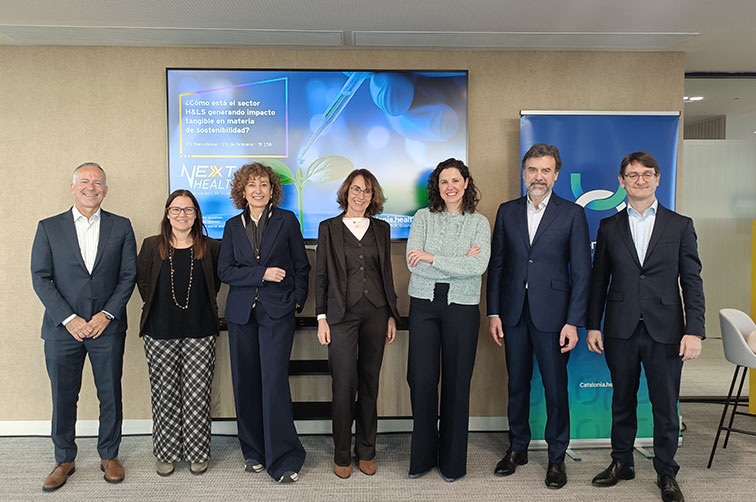
Barcelona, February 27, 2026 – Catalonia.health participated this week in the fourth edition of the "Next Health: Life Sciences Innovation" conference series, co-organised with EY, focused on analysing how the Health & Life Sciences sector is generating tangible impact in sustainability. The event brought together experts from leading companies to share concrete examples of transformation and advances in this strategic area.
Beyond Compliance: Sustainability That Creates Value
Eulàlia Griera, member of Catalonia.health's Shared Value Committee and Operations Liveable Planet Lead at Ferrer, opened the session by contextualising the challenges and opportunities facing the sector: "Sustainability goes far beyond regulations and indicators. We're talking about how we care for the essentials: people's health, the wellbeing of our communities, and the future of the planet we share." Griera identified three priority areas for action: value chain decarbonisation, improving efficiency in the use of critical resources, and integrating ESG criteria.
Visions from Leading Sector Companies
The round table, moderated by Antonio Capella, partner responsible for EY's Sustainability area in Catalonia, brought together sustainability executives from four Catalan pharmaceutical companies who shared their experiences and learnings:
Hipra: Territorial Impact and Quality Employment
Carlota Gómez de la Hoz, Chief Corporate Affairs and Sustainability Officer at Hipra, emphasised the comprehensive vision of sustainability: "Few industries like pharmaceuticals have such an impact on sustainability. Everything that involves investing in prevention is investing in sustainability."
She highlighted a concrete example of territorial impact: "Hipra has had an impact on the territory, in Girona, with the creation of 2,000 jobs. There's a deliberate decision to create territory by establishing ourselves in Girona, creating high-value-added jobs, and this is also sustainability."
Gómez de la Hoz also stressed the importance of commitment from top management: "There must be a commitment from the board of directors for sustainability measures to have impact."
Looking to the future, she added: "We must help reduce the external noise of current events to help make informed decisions and ensure that sustainability continues to add value to the company."
Reig Jofre: Collaboration for European Strategic Autonomy
Isabel Amat, director of Innovation and Sustainability at Reig Jofre, explained the company's evolution: "In terms of sustainability, we have evolved, we have consolidated compliance requirements. Sustainability has been there from the beginning, from our DNA, our mission, and compliance has only confirmed it."
She highlighted two key messages about collaboration: "We live in a world of constant alliances, long-term collaborative visions, to help build a more resilient future. We are, together with Hipra, one of the companies prepared for a pandemic, and this marks the path towards one of our key objectives: European strategic autonomy."
And she added a reflection on sectoral cooperation: "We don't compete, we collaborate to make a better world. Public-private collaboration is fundamental to drive improvements in health and sustainability. We all want sustainable health systems."
Almirall: Concrete and Measurable Objectives
César Hernández, Global Sustainability Executive Director at Almirall, presented the company's practical approach: "We have set and very concrete objectives in terms of sustainability, we track KPIs and conduct continuous review. This allows us to have consolidated and measurable figures on topics such as the origin of the energy we use. We have a headquarters that is carbon neutral, we're committed to photovoltaic energy."
Regarding future challenges, he stated: "We will rely on digitalisation and AI."
Esteve: Verified Information and Committed Talent
Maria Àngels Valls, Chief Communications and PA Officer at Esteve, reviewed the evolution of sustainability reporting: "Recalling the origins of sustainability in what were 20 years ago the first CSR action reports that were written. It evolved in 2018, when the new non-financial information reporting law required reporting more data. We are committed to having audited, verified information that allows us to properly explain that we do things well."
She highlighted the importance of talent: "Young people and new talent are more demanding and only want to be in sustainable, transparent companies. It's important to have alliances with universities, knowledge agents." And she added: "Communicating well what we do has a positive impact."
As a future challenge, she emphasised: "That organisations mature and understand that sustainability deserves to be at the top decision-making level of the company."
The Ecosystem as a Transformation Driver
Eulàlia Griera emphasised Catalonia.health's role as a collaboration space: "The purpose of Catalonia.health, which today represents 230 organisations across the entire health sector value chain, is clear: health companies are not just economic actors; we are an essential piece of society. We have the responsibility —and the opportunity— to lead by example and inspire changes that go far beyond our own walls."
The Importance of Sectoral Events
This fourth session of the series reaffirms Catalonia.health and EY's commitment to creating spaces for reflection and debate that enable the Catalan and Spanish healthcare ecosystem to remain at the forefront of sector transformations. Active participation in sectoral events such as this facilitates knowledge exchange, strengthens collaboration networks, and allows companies to advance jointly on shared challenges with a common strategic vision.



Comments