

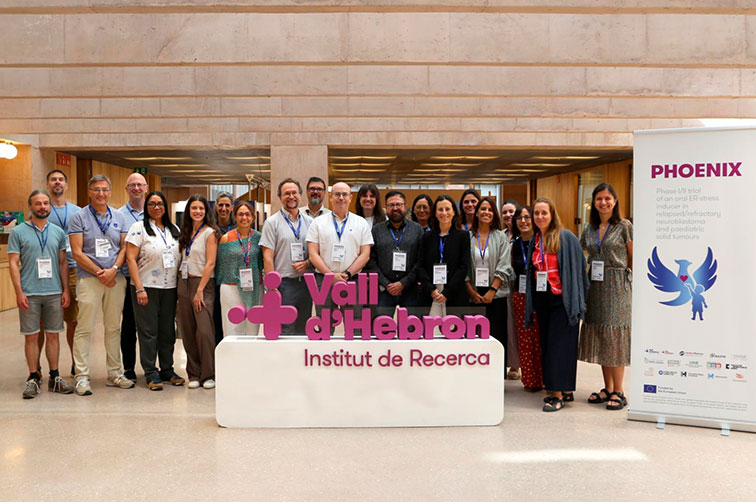
The Catalan biotechnology company AbilityPharma and the Vall d'Hebron Institut de Recerca (VHIR), both members of Catalonia.health, participate prominently in the European PHOENIX project, funded with 8.5 million euros by the European Union through Horizon Europe's Cancer Mission program. The VHIR assumes coordination together with the Vall d'Hebron University Hospital, while AbilityPharma contributes its experimental drug ibrilatazar (ABTL0812), which has the Designation of Rare Pediatric Disease by the American FDA.
A first pediatric clinical trial for ibrilatazar
PHOENIX will promote the first phase I/II clinical trial of ibrilatazar in the pediatric population, aimed at boys, girls and adolescents aged between 6 months and 18 years with relapsed or treatment-resistant neuroblastoma, and with other aggressive solid tumors for which there are no therapeutic alternatives.
The trial will evaluate ibrilatazar in combination with chemotherapy or immunotherapy, as previous studies have shown that it can enhance the effect of these treatments without adding toxicity. The main objectives will be to establish the recommended dose of the drug and evaluate its safety and antitumor activity. In parallel, possible predictive biomarkers will be investigated, including liquid biopsy based on circulating DNA analysis, to anticipate the evolution of patients and their response to treatment, and the perspective of patients and families on quality of life and acceptability of treatment will also be collected.
The start of the trial, in which around 50 patients will participate, is planned for 2026, after the completion of the ETNA study, currently underway, which will determine the dose of the drug for the pediatric population. To facilitate administration in children, a specific oral suspension formulation is being developed, instead of the capsule used in adults.
A new therapeutic pathway to reduce side effects
Ibrilatazar works differently from traditional chemotherapy: instead of damaging DNA, it induces the selective death of tumor cells by activating natural cellular defense mechanisms and preserving healthy cells. Ibrilatazar has shown excellent tolerability and signs of efficacy in phase 2 clinical trials in adults with pancreatic, lung and endometrial cancers, and has achieved good results in preclinical studies in neuroblastoma models.
Statements of those responsible
Dr. Lucas Moreno, head of the Pediatric Oncology and Hematology Service at the Vall d'Hebron University Hospital and co-responsible for the VHIR's Children's Cancer and Hematological Diseases group, has pointed out that children and adolescents with cancer need therapies adapted to their biology and age, which are effective but also less toxic, and he has emphasized that with this study alternatives are sought that not only prolong life but also improve the quality of life of patients and their families.
Dr. Miquel Segura, co-head of the VHIR's Cancer and Hematological Diseases Children's group and coordinator of the project, has emphasized that the trial is the result of many years of rigorous research in the laboratory, and has recalled that his team participated in the characterization of the mechanism of action of ibrilatazar in cell and animal models before reaching this clinical phase. Segura pointed out that seeing how this effort takes shape in a real option for children and teenagers with cancer is a great satisfaction and a source of hope.
Dr. Carles Domènech, CEO and co-founder of AbilityPharma, has remarked that the mechanism of action of ibrilatazar opens a different therapeutic pathway, with potential application in various types of tumors, including pediatric ones, and has emphasized that collaborating with the VHIR in this academic trial is an opportunity to advance towards safer oncological therapies for the child and adolescent population.





Comments