

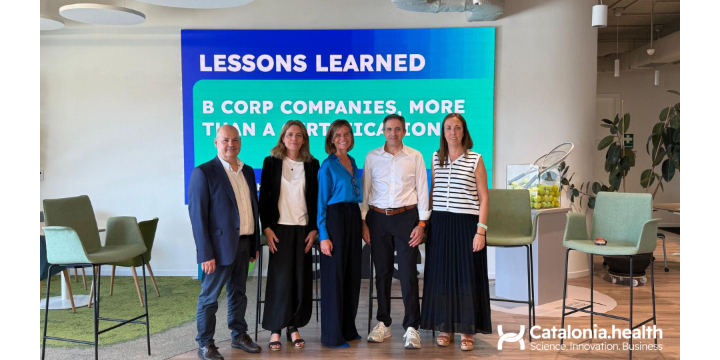
Under the title "B Corp companies, much more than a certification", Catalonia.health brought together professionals from Ferrer, MITON, Medichem and Klinea to share, first-hand, the experience of becoming B Corp companies. The session, promoted by the Internal Shared Value Committee within the IMPULS program, took place at the Ferrer facilities and was moderated by Mireia Ferré, Director of Sustainability at Dentaid.
A certification that moves the organization from top to bottom
All four speakers agreed on one starting point: the B Corp certification process is not a marketing exercise or an administrative milestone. It is a process that requires reviewing practices, mobilizing teams and making decisions that impact the entire company. Jordi Isanta, CEO of MITON - a company in which 90% of the staff are people with some kind of disability - summed it up with humor: "Yes, we're a little crazy for being a B Corp." And he added that the big challenge was, precisely, to believe what they were already doing: "We were already doing most of the good practices. We were a B Corp and we didn't know it."
Marta Anglada, Business Director of Impact at Ferrer, emphasized the courage the process requires: "You have to be very brave to be a B Corp." Ferrer, which has already passed two certification processes, has integrated B Corp to the point of including actions related to certification in employee bonuses, and today it is positioned as the best-rated pharmaceutical company in the world in the BIA.
On behalf of Medichem, Maite Sánchez highlighted the challenges of managing the supply chain on a global scale, internal engagement and adapting own metrics to the required standards. He emphasized that "the shareholder family was at the forefront of the initiative, and this support was very definitive to achieve it", and that having an external partner greatly facilitated the process. From Klinea, Oriol Sauquet pointed out one of the most valuable effects of the certification: "It has helped us to value and become aware of powerful assets that we had and did naturally, such as the corporate culture" - elements that the organization had but had not named or measured until then.
Internal and external impact: engagement, positioning and community
Beyond the certification itself, speakers described a cross-cutting impact. Internally, all companies agreed on the positive effect on team engagement and cohesion around a shared purpose. Externally, in B2B environments such as those in the health sector, the label acts as a brand positioning tool and, in some cases, has opened doors that were previously closed.
Internal communication emerged as one of the key elements of the process. Marta Anglada insisted on the need to create transversal teams - "This is not just about sustainability" - and to celebrate progress. For companies that are considering starting the path, moderator Mireia Ferré reminded that there is an accessible first step: the initial key assessment, free of charge, which allows a first diagnosis to be made in approximately three hours and to identify where the organization is.
Four words to take away
The moderator closed the round table with a summary that condensed the spirit of the entire session: wanting, changing, helping to communicate and celebrating. Four verbs that describe not only the B Corp process, but the philosophy that underpins Catalonia.health's Lessons Learned: sharing real knowledge, generously and without sweeteners.
The session concluded with an active question and answer session and a networking space that extended the conversations beyond the program.
Catalonia.health's Lessons Learned conferences have been held since 2014 and constitute a forum of reference for professionals in the health and life sciences sector. The next session will be published soon on the IMPULS program website.
With the support of ACCIÓ.



Comments