

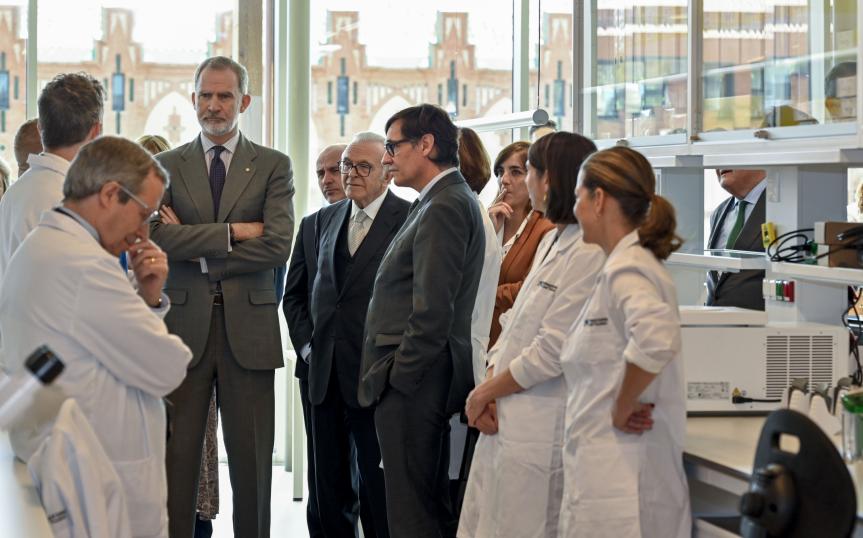
Majesty King Felipe VI has inaugurated the CaixaResearch Institute, the first center dedicated entirely to the study of immunology in Spain and Portugal, and one of the pioneers in Europe. The new institute, promoted by the "la Caixa" Foundation and a Catalonia.health member, represents an investment of €100 million and strengthens Catalonia's biomedical research ecosystem.
State-of-the-Art Facilities for 500 Professionals
The CaixaResearch Institute has 20,000 square meters of facilities equipped with cutting-edge technology and capacity to house 500 professionals, 425 of whom are scientists, who will work in a cross-disciplinary manner to unravel the keys to the functioning of our immune system—the body's first line of defense—and its relationship with the most prevalent diseases.
The institute has a budget of €10 million for 2026, allocated to recruiting talent and acquiring scientific equipment, with the aim of establishing itself as a leading center in immunology.
Scientific Structure and Governance
The Scientific Committee of the "la Caixa" Foundation, chaired by Javier Solana, has played a strategic role in defining the vision of the CaixaResearch Institute, which represents a step forward in the foundation's commitment to science as a driver of transformation. In addition, the institute has its own Scientific Council, led by oncologist Josep Tabernero, which ensures that its progress aligns with international standards of scientific excellence in immunology.
The Scientific Council also brings together the directors of other centers linked to the "la Caixa" Foundation, such as IrsiCaixa, VHIO, ISGlobal, IRSJD, and the Portuguese GIMM, consolidating a high-level model of scientific collaboration. Dr. Arcadi Navarro, director of the Barcelonaβeta Brain Research Center (BBRC), has been appointed as a member of the Scientific Council, opening up new opportunities to advance in the study of neurodegenerative diseases like Alzheimer's.
Three Main Research Areas
The center's activity will be structured around three main areas: immunology and diseases, exposomal sciences, and systems immunology and engineering. Currently, the institute has already begun work with six scientific groups, and it is expected that in the coming years this number will grow to 40-45 research groups.
Sustainable Architecture Integrated into the Landscape
One of the architectural challenges of the project has been its location between the Collserola mountain range—an area of outstanding environmental value—and the Ronda de Dalt, one of the main arterial roads of the city of Barcelona. For this reason, the architectural solution was inspired by the tradition of early twentieth-century hospital and hygienist architecture, characterized by independent pavilions open to the outside.
The project features a sequence of low-rise pavilions interconnected by courtyards and gardens arranged in a stepped pattern to adapt to the natural slope of the terrain, allowing the building to blend seamlessly into the landscape. In April 2026, the first of the two CaixaResearch Institute buildings was inaugurated, and it is expected that the second building will begin to be occupied progressively throughout 2027.
Furthermore, the new institute was designed according to criteria that prioritize sustainability and environmental protection, utilizing renewable energy sources ranging from photovoltaic panels to geothermal probes. Plans also include the use of rainwater harvesting and internal reuse systems to reduce energy consumption by 38% and water consumption by 40%.
Strengthening the Biomedical Research Ecosystem
The CaixaResearch Institute joins the extensive network of research institutions supported by the "la Caixa" Foundation. This cluster includes IrsiCaixa (infectious diseases and immunity), Vall d'Hebron Instituto de Oncología (VHIO), ISGlobal (global health), Barcelonaβeta Brain Research Center (Alzheimer's disease), Institut de Recerca Sant Joan de Déu (pediatrics), as well as the Gulbenkian Institute for Molecular Medicine in Portugal. In total, more than 1,500 researchers work within the foundation's ecosystem, with a combined annual budget exceeding €200 million.
Barcelona continues to strengthen its status as one of the leading biomedical centers in Europe. The city already brings together major hospitals, universities, and companies in the sector. The "la Caixa" Foundation allocates approximately 20% of its annual budget to healthcare, and by 2026 this amount will reach €147 million.




Comments