

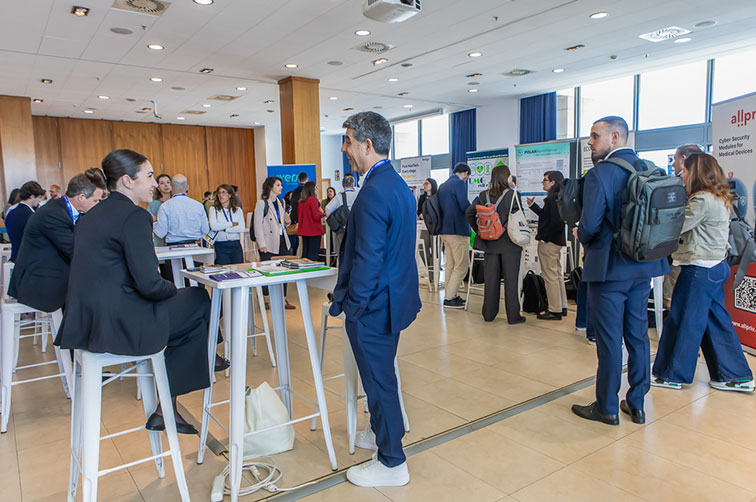
Barcelona, May 6, 2026 — More than 250 professionals from the health sector gathered on May 6 at the World Trade Center in Barcelona for the fourth edition of the main B2B connection event of the Catalan health ecosystem.
The Connection Day 2026, organized by Catalonia.health, has celebrated its fourth edition with a notable success in terms of participation and content. The event, held on May 6 at the World Trade Center in Barcelona, was consolidated as the reference B2B meeting point for the health sector in Catalonia, where more than 250 professionals from the entire value chain gathered: startups, companies, investors, hospitals, research centers and institutions.
An opening with a vision of the future
The opening ceremony was held by Eva García Ramos, new president of Catalonia.health, who welcomed the attendees in her first official ceremony in this position. She emphasized that the Catalan health ecosystem is already a benchmark, but that it has enormous potential ahead: "This is where opportunities become visible, conversations turn into alliances and ideas turn into action." The president emphasized the key moment the sector is experiencing: "Innovation is moving forward at high speed, but so are the challenges: we need more investment, more knowledge transfer and greater coordination between all the agents of the ecosystem." And she concluded with an idea that sums up the spirit of the association: "Collaboration, in health, is not an option: it is a necessity."
The institutional welcome was given to Joan Romero, executive director of ACCIÓ, who highlighted the strategic role of the health sector for the Catalan economy: "Where Catalonia is in the Champions League is in health, and it must be highlighted in all possible scenarios. You have the government on your side. Bet on innovation and we will be there".
Investment, public-private collaboration and geopolitics: the three axes of the morning
The morning sessions at the Espai Àgora revolved around three main axes that define the future of the health ecosystem: investment, public-private collaboration and strategic navigation in a fragmented world.
Firstly, the Investment Study in the Health Sector 2025 was presented, prepared jointly by Catalonia.health and EY, which analyzes the main indicators and trends of business investment in the health sector in Catalonia. The report covers the opportunities and challenges of the sector and is available on the Catalonia.health website.
Next, a round table moderated by Arturo Urrios (Partner at Ysios) explored new investment instruments and public-private collaboration models, with the participation of representatives from Ship2B, Inveready and Asabys Partners. Cases such as the InceptionBio fund (€100 M) and Montana Children's Health (€55 M) were highlighted, and the potential of the new European Biotechnology Act (EU Biotech Act) was analysed.
Vanessa Servera, General Director of the Catalan Institute of Finance (ICF), presented the new “Catalunya Lidera Health” Transfer Fund, with a budget of €60 million (€50 million from the Catalan Government and €10 million from the ICF), which will support innovative projects in the field of health and life sciences from Catalan universities and research centres. Servera emphasised: “We have an ecosystem ready to grow. Our aim is to support Catalan companies so that they can grow and bring their projects to fruition in their earliest and riskiest stages.” She announced that the fund will be fully operational in two weeks.
The last intervention of the morning corresponded to Sol Magaz, partner of Health and Life Sciences at EY-Parthenon, who presented the session "From conflict to impact: strategic implications for the health sector in a fragmented global context". Magaz warned about the three hot spots that are disrupting the life sciences today: the Russia-Ukraine conflict, the tension in the Strait of Hormuz and Taiwan's reliance on medtech chips. He concluded: "Geopolitics is at the forefront of our strategy. We operate in three systems of innovation: the EU regulates for trust, the US for speed and China for scale."
Research and investment: talent that finds capital
The day continued with two sessions of great interest. On the one hand, the presentation of 6 innovative projects from Catalan research centers, universities and hospitals, moderated by Roser Alba (Catalonia.health), and which included proposals from EURECAT, the University of Barcelona, the UAB, Hospital Sant Joan de Déu, the Blood and Tissue Bank and the VHIR. On the other hand, the Health Investment Program with ACCIÓ brought together 8 startups—Allpriv, Ephion Health, Flavii Therapeutics, Foresee, Nanobots Therapeutics, Oniria Therapeutics, OrganAID, The Smart Lollipop, QMENTA and Qrem—who made their pitch in front of a panel of experts and investment funds, in a session moderated by Rocío Flor (ACCIÓ).
In the afternoon, the Job Marketplace took place, organized in collaboration with Barcelona Activa, which connected talent and job opportunities in the biomedical sector, with nearly 100 registered candidates.
Real connections: B2B, exhibitors and talent
Beyond the plenary sessions, Connection Day 2026 highlighted its three distinct spaces. The Aqua Space hosted the B2B Partnering area, with almost 200 one-to-one meetings scheduled between companies, investors, knowledge centers and ecosystem agents. Espai Port Vell hosted the Exhibitors Zone, with 33 companies exhibiting their innovative solutions.
Institutional closure: public-private collaboration for a healthier Barcelona
The day closed with the words of Marta Villanueva, Councilor for Health, People with Disabilities and Strategy against Loneliness, of Barcelona City Council, who reaffirmed the municipal commitment to public-private collaboration: "Events like Connection Day allow us to continue generating synergies and added value in the city, establishing collaborations that enlarge and make the health ecosystem stronger. We will continue to work to promote these opportunities."



Comments